Who Trains the Trainers? And Why Detailers Should Get Assessed
Detailing is an ungoverned, unregulated industry – which raises an awkward question for us and anyone trying to put a stamp on who is doing the job correctly: Who trains the trainers? Who checks the checkers?
There’s a suitably grand Latin phrase for exactly this: Quis custodiet ipsos custodes? – “Who will guard the guards?”.
I don’t actually speak Latin. I’ve never seen the necessity – but it turns up in a Terry Pratchett book, so trotting it out makes me feel briefly clever by speaking in a dead language. Which I am not.
It’s a fair question in an industry like ours though. With so many companies offering training, certification, and accreditation for the latest wonder product, it can be genuinely hard to tell those who pass on relevant, understandable and useful knowledge from those who’ll just use you as free labour cleaning a customer’s car under the guise of “shadow learning”.
So how do you tell the difference – and how do professionals prove we’re not just marking our own homework and calling ourselves experts? That’s where getting independently assessed comes in, both for professional detailers and those training them.
Who has the ability to assess me (or you)?
First things first. There is NO government qualification in detailing. We go into that in another blog, but that’s really important to understand when people wave certificates and pieces of paper at you. It doesn’t (currently) exist, so a piece of paper is only worth as much as the skills it give you. No more.
In the UK, there are two independent trade bodies dedicated to the assessment and accreditation of Detailers and Valeters.
The first is PVD – the Professional Valeters and Detailers Association – a UK Based not-for-profit whose aim is to promote higher standards and assured features, such as insurance records and good customer service, amongst its members. You have a practical and theory test, which focusses less on the day to day skills, and more on the process and efficiency management which ultimately makes a successful and trustworthy business.
The other is the IDA – the International Detailing Association. The IDA started life in the USA, backed by some pretty well-known names, and have since set up chapters in India, Southeast Asia, New Zealand, Belgium, France, the UK, and other countries, to standardise detailing knowledge and processes globally, exchange information and skills, and promote the industry to the public. These are more skills and knowledge based, but can serve to show your technical ability in a particular subject or module.
Our experience with accreditation
As both trainers and professionals, we’re always on the lookout for ways to improve and expand our knowledge base – there’s no such thing as “finished” when learning to detail, as there’s development happening all the time. Unfortunately for us, we couldn’t take the PVD examination, as we wrote and developed it for them – it seemed a bit of a cheat, really.
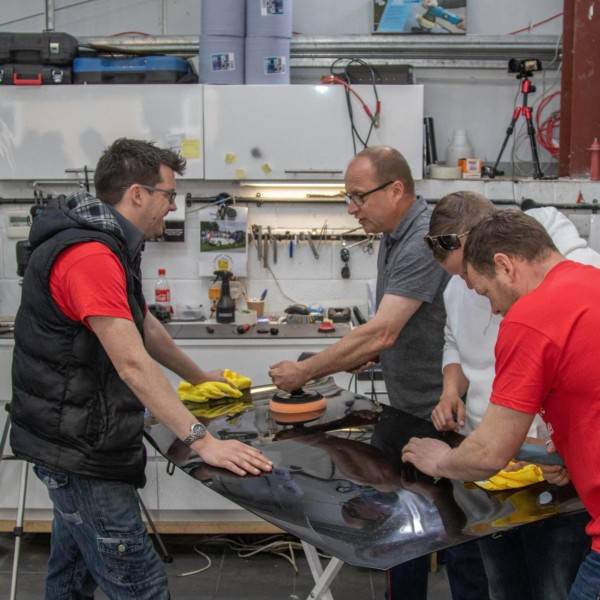
However, when the opportunity arose to book a date with the IDA to be assessed and accredited, we signed up, completed our online CD (Certified Detailer) theory exams, and a few weeks later headed up to one of the few RTs (Registered Trainers) in the country at the time, at Gtechniq in Northampton to complete our SV (Skills Validated) assessment with Adam.
We each covered chemical knowledge, exterior washing, interior care, product knowledge, machine polishing and general detailing knowledge in a two-hour, one-to-one assessment.


We all passed!
The next step for us was to progress to establish Recognised Trainers at the Academy, to give others the opportunity to self evaluate, and gain recognition of their skills.
Which we did!
In fact, since doing the exams, not only are we one of three RITs, UK Detailing Academy are the ONLY Recognised Training Centre (RTC) in the UK, able to deliver exams for car, motorbike, RV and watercraft assessments. We’re even helping write the new ones and update existing certification to keep them relevant and current in the ever changing industry.
So why doesn’t every professional do this?
The detailing “community” – and by that, we mean a fairly small but vocal group – seem to have an issue with people assessing and passing comment on their skills.
We’ve read comments on various threads over the years, ranging from; “What gives them the right to assess me” to “A badge won’t get me more customers or work…”
Frequently though, this is on the same page, and sometimes even in the same discussion thread, which these people complain about there being “No regulation in the industry“, and griping at the bloke down the road charging a tenner for a full machine polish.
This seems like a bit of a chicken-and-egg problem.

Some may not have the confidence for assessment – Imposter syndrome is rife in our industry, with experienced detailers and valeters sometimes not realising the value of the skills and knowledge they have acquired over time; to those, we would say – Try!
You’ll either pass, and have your well-earned confidence boosted, or you won’t, and you’ll find advice on ways you can improve your own business!
There’s no shame in failing whilst learning, it’s private, and failing is how you learn! If you do learn, improve and engage with it, you will come out with a better business on the other side. That’s a win for you, your customers, and the industry as a whole!
The only people who will know you fail are the assessor and yourself, and frankly, if you’ve been doing the job long enough, your only struggle will likely be thinking in more basic terms again – because the exams are not about proving you’re the best, they’re about proving you’re competent.
Dare to Know
As for those who believe they’re “too accomplished” for assessment – perhaps, if everyone swallowed their pride a little and got behind the organisations trying to raise standards, the recognition of these badges would grow, and those badges would start pulling in more custom and work as a result. It might earn cheaper insurance off the back of a demonstrably professional approach, or sharpen your efficiency by forcing a look at newer techniques – and ultimately make more money.
There’s a saying in hospitality: “every satisfied customer tells three people, every dissatisfied customer tells ten”. So picture a dissatisfied detailing customer warning ten people off the uninsured hack down the road, telling three of them the name of the detailer who did the work correctly to put it right, and passing on the message them all to look for a specific badge of recognition badge next time, so they don’t have the same problem. That’s a small slice of the public who now understand the difference. They tell three friends each – and if it happens for hundreds of professionals it then starts an avalanche of awareness, until maybe, just maybe, it clicks in the public’s mind and these bodies start to act as the grit guard in the detailing industry’s bucket: the chaff trapped at the bottom, whilst the approved and experienced float happily in the suds.
This brings us back to the Latin. There’s a companion to “Quis custodiet ipsos custodes?“, and it’s the one to leave you with.
If the first phrase asks “who checks the checkers”, this is the phrase for anyone confident in their craft:
Sapere aude – “Dare to know”.
Dare to find out where you really stand. Put your skills in front of someone with enough experience to judge them and assess where you could potentially improve. You’ll either walk away with your confidence properly earned, or walk away knowing exactly how to get better.
Either way, you come out ahead – which is why it’s good advice to live by.
Sapere aude – It’s good advice to live by, even if its the only Latin you know.