Detailing Aircraft Professionally – The Facts
Reading time – around 10 mins
Are you looking to start an aircraft detailing business? UK Detailing Academy receive daily enquiries to our inbox regarding aircraft detailer training, which has prompted this post to put a bit of perspective on the industry for those considering it. We cover what the job entails, the reality of the administration and regulation work, the skills you will need to develop and the restrictions you will have to overcome.
It’s one we’re going to be pointing people to read through before they attempt to move forward, as there is much more to aircraft detailing than turning up at an airport with a jetwash and machine polisher, knocking on doors to see if anyone wants their plane washed…

Who do you train in aircraft detailing?
Generally, UKDA will only train and work with companies that are either already established within the industry, with a working base and demand in existence, or have a solid route to market in place. This isn’t exclusionary, but realistic. Without either of these, you will have all the skills, but struggle to find somewhere to apply them.
Firstly, understand that Aircraft detailing is a niche. It’s not like car detailing where you can; publish a website, put some stickers on a van, and with a bit of marketing you’ll start getting calls from the millions of car owners around the country to wash their vehicles. There are around 23,000 private business jets registered in the world, and around 82 CAA-licensed airports, of which 10–15 are active business aviation sites where meaningful detailing work is concentrated. You can add in Helicopters and prop aircraft to the figures if you wish, but it boils down to a far smaller market at limited lications. Private strips and estate airstrips are a less restricted entry point, but with minimal work and individually negotiable, meaning less return for the time invested.
Airport people are networked, so you will need to put in a proportionate amount of time just making contacts, meeting potential clients and building some trust around your name.
Your local airport might be convenient and near your house, but if it has an exclusive contract with another company or a single FBO (Fixed Base Operator), you’ll have to compete or look further afield, because aircraft owners aren’t going to be able to come to you. Access is restrictive, and typically involves a criminal record check (DBS), airside safety training (often bespoke to that airport), and sponsorship by a based operator or the airport itself. Some airports charge for passes.
We have not, and never will, say that training alone gives you a business. It gives you the skills to complete the tasks necessary for business, massively reduces your mistakes and learning curve, and guides you on which mistakes to avoid and the techniques to use, all from experienced professionals.
We support every single student we teach for as long as they ask for it, however a huge amount of the work in this sector will fall squarely on how well you can sell your services, how confident you can make your clients, and how well you can fulfill not just the requirements of cleaning and servicing aircraft, but all the grind of building networks, maintaining records, and the paperwork that goes hand in hand with such a high prized business.
We would love to help thousands of startups to set up aircraft detailing businesses around the globe – but we won’t set you up to fail if you don’t have a realistic prospect of getting a foot in the door.
So what does it entail?
How similar is it to normal vehicle detailing?
If we had to compare the hypothetical skillset split needed to run a business related to car detailing, versus that for aircraft detailing, day-to-day car detailing would probably be about;
- 65% skill, process and technique,
- 20% sales and customer service,
- 10% administration and business
- 5% “specialist” model knowledge – as much as cars have their individual “personality”, there are so many industry constants for cars that it’s only in very niche markets and jobs that an in-depth marque knowledge becomes relevant, beyond the odd Google search about fuel cap release location and wiper service modes.

Switch this to Aircraft detailing, and you’re looking at a business landscape more like;
- 35% skill, process and technique,
- 20% specialist model knowledge
- 35% administration and business
- and 10% sales and customer service

That’s not because the skills are less important, the work is any less difficult, or the quality of service is reduced – but because so much more of the other aspects, such as risk assessments, paperwork, insurance, CAA assessments, etc., become relevant as part of your day-to-day business of functioning. It’s not smaller slices, just a far bigger cake to carve up.
You will have to become a savant in clipboard handling, know your chemicals, surfaces, risks, procedures, and PPE inside and out just to open the doors in the morning at anywhere but the most basic of aircraft hangars. Only once everything is filed, duplicated, and stamped can you actually get on with the physical work…
Don’t underestimate this aspect – the image below is just one page of an eight-page document on a process for removing fine (wash/wiper) scratches from an Airbus H145 helicopter windscreen, the instructions, approved materials and procedure for which will vary from each manufacturer and model.
Everything in a commercial environment has a documented process, and every document has to be signed off when complete and logged. Every engineer will want a copy to cover themselves from liability.

What Knowledge Will You Need?
In terms of skills and technique you will be using, there is a crossover between road vehicles and aircraft in terms of process, especially at the higher end of the vehicle spectrum.
For example, the paint is essentially the “same” from a correction and machine polishing/protection and process point of view, though they are generally polyurethane for flexibility and longevity. Wash processes will depend on the individual airport’s regulations – some allow wet washing, whilst many will only allow dry.
The real difference you’ll encounter is the substrate range and working conditions, with the lighter-weight materials used on aircraft requiring a bit more knowledge in order to safely work with, and access to aircraft areas limited by available hangar equipment. Working out how to access an area suspended in mid-air, surrounded by sensitive equipment and “NO STEP” graphics, becomes a thought exercise in itself.
Regulation Compliance
You also have aircraft “type approval” to consider.
Many aircraft insurers will insist on type approval for various chemicals used and any repairs or coatings. This is to ensure that nothing used additionally on the original airframe will have the remotest impact on aircraft safety.
E.g. – If you clean a car navigation screen and it stops working because of moisture, the customer can pull over, or survive without the screen for a while.
– If the screen in a cockpit stops working mid-flight, your ability to “pull over” turns into an emergency, and a semi-blind mayday landing in many cases…
Chemicals, within reason, should be approved to ensure they effectively clean without damaging aircraft surfaces, with traceability, documentation and assessment to support their use.
 Flammability Weight and Balance: Must not adversely affect aircraft performance Durability: Must withstand environmental conditions like temperature extremes and high-speed airflow
Whilst this may seem extreme for a shampoo, degreaser, or coatings, the basis of “nobody expects these to cause an issue” is what leads to unexpected issues, and unexpected issues are unwelcome at several thousand feet, or in a hangar full of sensitive equipment. It is said that health and safety law is written in blood. Aircraft regulations and procedures are written in the same ink as accident reports.
What will I need to do on the job?
The core practical skills we recommend acquiring for a comprehensive aircraft detailing business would be;
- Machine polishing – for exterior surfaces, interior on some aircraft, metal polishing and polycarbonate correction.
- Exterior Cleaning – wet and dry technique, cleaning equipment, inspection, processes, and chemical restrictions.
- Interior cleaning – the range of materials (and stains) you’ll find on an aircraft is broad and, at the higher end, comparable to custom and luxury road vehicles, so knowing the base theory and processes to adapt is essential, and stretches beyond what you would typically find in road vehicles.
- Leather repair – almost EVERY high-end aircraft will require leather repair/colouring at some point, and if you can offer it under one “roof”, you’re opening a potentially huge revenue stream of cleaning and protection, running repairs, and full restoration.
- Coatings – ceramic and polymer for various applications throughout the airframe and fixtures, and where not to use them, and the upsell benefits you can provide.
- Chemical knowledge – knowing what is happening on a chemistry level will allow you to adapt your chemicals to situations and materials to ensure no damage is done, and you can assess and address contaminants swiftly.
- Health and safety – working air-side, in hangars, or for any business with a commercial aspect to aircraft will require a ream of both initial and ongoing paperwork to be compliant. It’s also the biggest challenge to working on aircraft, as there are many approvals and compatibility tests required for products which stay on the aircraft after application.
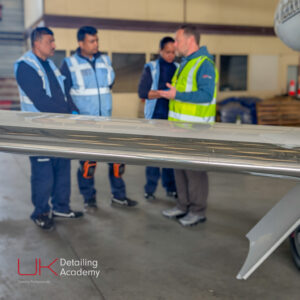
These modules are all topics UK Detailing Academy will assist with through a combination of course modules already on offer, and are fully adaptable to aircraft because the base skills are the same. From machine polishing to leather repair, and health and safety, we can give you all the SKILLS you will need to succeed, but there’s more to it than just the practical skills…
The day-to-day
In addition to all the above, you will also need to build a deep understanding of individual aircraft in general – such as what you can and cannot touch, wipe, pull, climb on, polish safely, etc – and perform research on the aircraft type before working on a new platform.
As a single example, identifying static vent locations on rotary aircraft.
Getting polishing compound stuck in static vents will be less noticeable at ground level, but when in the air the next day, the pilot won’t know their altitude or how fast they’re going… which is fairly crucial.
Whilst you can be a “jack of all trades” and work on any aircraft, having a speciality may also be beneficial – especially on jets. Knowing the ins and outs of a Gulfstream and advertising yourself as such narrows your focus market down, and you could find yourself flown around the world as a “specialist” in demand. However, a rounded knowledge is important – the full version of the idiom is “A jack of all trades is a master of none, but oftentimes better than a master of one” – so have a speciality, but be able to adapt it to whatever business throws at you…
Insurance
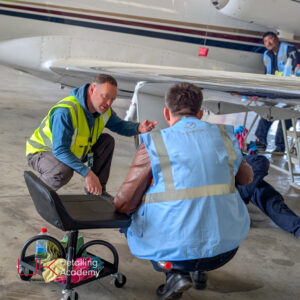
Finally, insurance. This is the usual stumbling block for entry aircraft detailers in the UK, both from an availability and cost point of view – these airside policies can cost thousands upon thousands a year to maintain, alongside the increased overhead in paperwork and documentation for both your own records, and commercial companies who may employ your services.
Airports typically require contractors to hold specific liability insurance, including aviation-specific liability cover — often with the airport named as an additional insured, and with minimum cover levels that can be £2–5m+. These are difficult to come by, especially without experience, making it a chicken-and-egg situation of not being able to get insured because you’ve never been insured…
Will a detailing policy not cover aviation detailing?
Detailing companies who attempt to clean aircraft under a standard car detailing policy will, at best, have their policy cancelled by their insurer – yes, they have employees who look at your business’ social media posts…
At worst, though, if something has gone wrong, and your insurer not only cancels the insurance policy but also repudiates any claims, leaving you with a personal lawsuit for losses from an angry aircraft owner or company. It’s not the sort of thing you typically financially recover from. Get insured correctly.
So, is it worth it?…
There’s a lot to cover, both in training and just building the business, making the contacts, and enhancing your knowledge of the aircraft you’ll be working on. It’s not the sort of thing you can learn in any depth from an online course, or in a short session shadowing a professional, and expect to succeed.
However, it’s also both immensely satisfying and financially rewarding working on aircraft – we’re quite unique in that, as part of another business, we have long maintained air ambulance and electricity helicopters around the UK, so are well-placed to give you insights into the industry from a practical perspective.


Whilst this might seem like an article to put you off getting into detailing aircraft, it’s anything but that.
It’s simply an early, and frank, heads-up. An eye-opener, that; whilst there is a fantastic and highly profitable business to be built, unless you are realistic and aware of the work it will require, you may find yourself out of your depth quickly, and struggling if unprepared for the reality of running a major business.
The internet, and social media in particular, is great at making difficult jobs look easy, without a glimpse at all the hard stuff to counter the illusion.
The administration.
The networking.
The meetings to establish contracts.
Developing a business to flourish and expand.
The money earned is charged for a reason, not just because it’s an opportunity for huge profit and an Instagram lifestyle. The rewards are certainly there with the right preparation and knowledge, and UK Detailing Academy can equip you to succeed and grow.

Still interested? Give us a call to discuss further, and we’ll help you get started.