
Can You Learn Detailing Online?
At UK Detailing Academy, we get requests and enquiries for remote training every week, usually from people around the world who just can’t justify travelling to a different continent to receive our brand of tuition. It’s something we have considered, and we’d love to be able to help with it, but every time we do it comes back to the same issue. You just cannot remotely teach a physical skill as effectively as you can in person. You can certainly pick up theories and see how other people do the work in 2-dimensions, but to pick up a practical, hands-on skill you need to get hands on yourself.
What videos can (and can’t) teach
Whilst there were obvious downsides and difficulties during lockdown a few years back, it did afford me some great opportunities to train myself in some new skills, remotely. I work a lot with digital design programs, and managed to complete several distance learning courses with the power of the internet and video lessons, just by sitting in front of a computer and following an instructor along. And I got pretty good at it. You can learn a language – though without someone to converse with you may not develop it well, and you can learn theory and gain guidance on everything from fitting and exhaust to baking a cake, but when your bolts are seized on, or the cake mix separates – you don’t have the 3-dimensional knowledge and background skills to solve the problem.
You would think it is a no-brainer opportunity for any training business to record and bash out its entire syllabus onto YouTube and monetise it? It’s money for old rope really, with a bit of time upfront for the series creation and well spread out content to really up the viewing figures for the channel!

This is in no way a dig at YouTube, or forums, or anyone willing to assist over the phone when you have an issue – just at the the idea that these mediums can somehow replicate the benefits of physical training.
Yes, there is a lot of theory you can learn from videos, how-tos and online written guides up to a point. But there is a huge gap left when the skills are physical or require any amount of variation.
No two cars have exactly the same issues, and for the best education you need to be taught in a much more rounded fashion, with a foundation in the why and how things work, in order to equip you with the knowledge to deal with changing situations on the fly – when processes go wrong or aren’t effective.
Technique needs a hand on your shoulder
Take learning machine polishing for an example.
When starting out, using a machine polisher is a lot like playing the drums. There’s a lot of things going on at speed, and you have multiple variables you need to balance out in order to get the results required and you have to adjust everything to work in harmony.
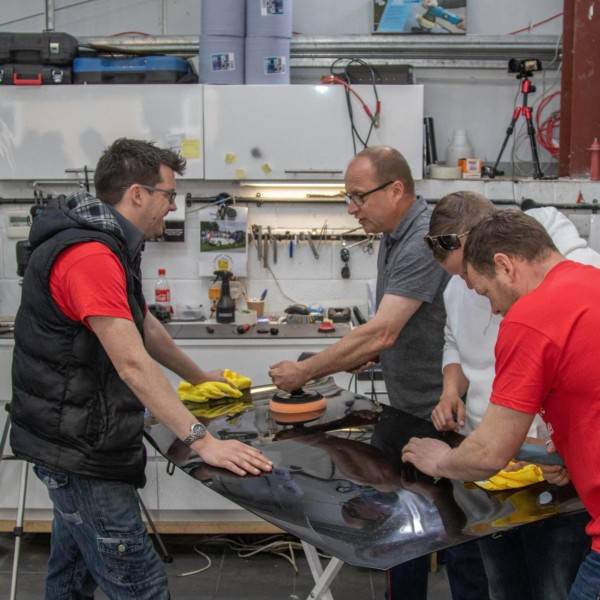
I’ve lost count of the number of times when training someone how to polish that I’ve casually adjusted the back of a machine, or tilted the head one way or the other, whilst a trainee is concentrating on only their body movement to keep the pad from running away on the panel – and by physical, repetitive correction, you notice they self-adjust automatically after a few nudges. This is the type of interaction you can’t get from a video.
We pulled up a “how to” guide on machine polishing online, and filled in some of the details to show the crucial gaps a basic guide misses out:
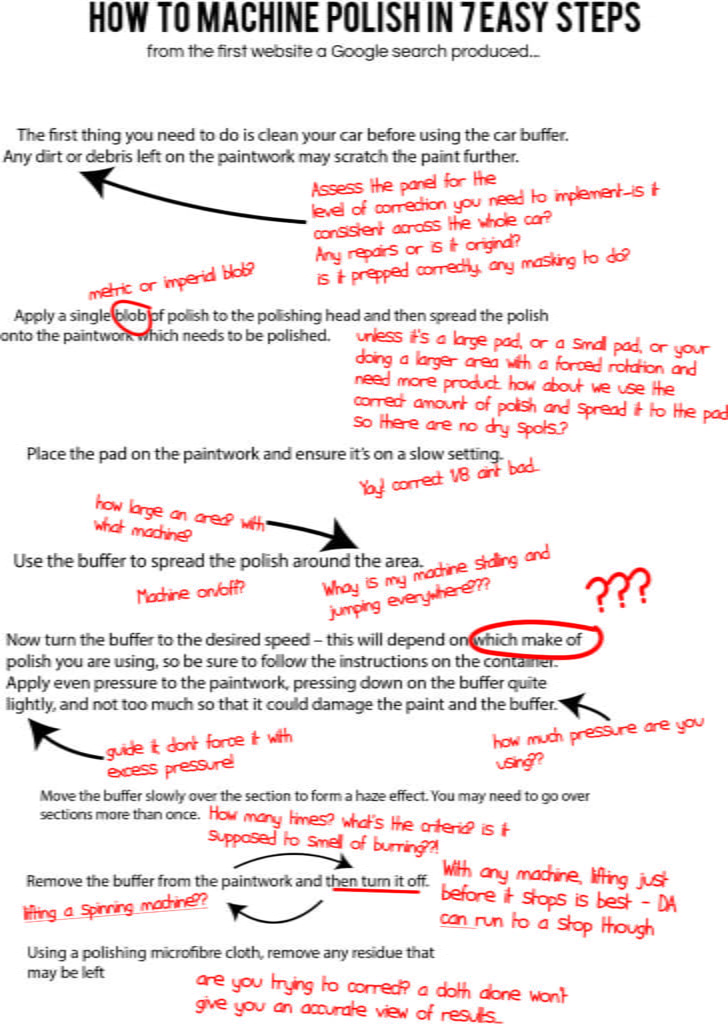
Huge gaps in the general guidance, but a reader who has never polished before won’t know that, and without someone there to tell them it’s making them guess 50% of the task…
Everyone learns at a different pace
Interactivity is crucial in a classroom session for trainers to teach effectively, because everyone is different and everyone learns at a different pace. Some come in with an understanding of processes which may be relative to a previous career but fall over at points some may consider obvious. Some may respond better to theory>practical, some gain better understanding via the show then explain of practical>theory. Even our group courses are limited to small numbers, because if a group comes in with half semi-experienced and half zero-experience, we can divide the group down and adjust the pace to suit. One video will not serve every viewer well, and understanding half of a “lesson” is almost as potentially damaging as not watching the video in the first place.
The potential cost of going it alone
Finally. There is a cost element to face-to-face training that makes free videos appealing – we’re no so naive as to think otherwise.
However, we would frame it as an upfront investment vs the savings in time and money you’ll make going forward. This could be weeks in new skill trial and error and the repairs you may have to cover, through to years with business development, building a name for yourself and finding a niche where you operate successfully. Not having to ride this learning curve is a medium and long-term saving, and profit, vs the cost of getting it wrong or developing slowly.
We’ve collectively been in this industry long enough to have made all the mistakes, because the training simply didn’t exist. With guidance and demonstration, you get to pass Go, roll a double, and get a heads up on free parking – because you’ll already have this knowledge.
Where video genuinely helps
Do not misinterpret this as an attack on video learning. We’re by no means saying you cannot pick up tips and tricks from videos and get a gist of a skill.

We’ve done short tip videos, given remote advice where options are limited, and written many, many articles on key points which we hope are helpful to aspiring detailers! But they don’t add up to a full understanding of a topic, or the nuances and intricacies speaking in general terms can fall short on when trying to understand a subject or process.
Nothing is ever going to trump interactive learning from experienced professionals when starting a new career. Showing you how to adapt every skill, and what to do when things go wrong is just as – if not more – important than the basic skill and process you learn.
Know what’s gone wrong and you’re halfway to fixing it – and that’s exactly the kind of judgement we can only pass on with you here, hands on the machine. If that’s the way you’d rather learn, take a look at our Career Development courses for a career in detailing, or our Enthusiast days if you’re doing it for the love of it.