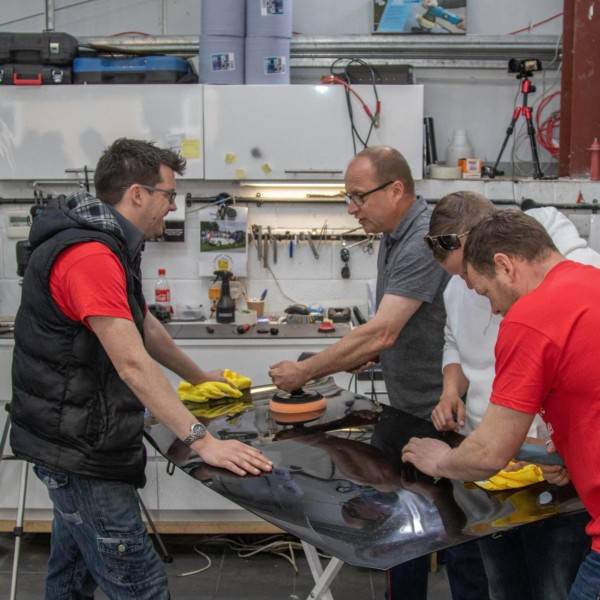
Part of the benefits you get for training with UK Detailing Academy is the ability to continually ask questions of us for as long as you need to.
No subscriptions, no product sales, just advice – as long as it’s vaguely related to the course you attended.
This one came in from a student who was having issues following a machine polishing course.
…The more I worked [the compound] in, especially on the bonnet, it started going stiff and pinging off little sticky balls of the compound as I went on, like it was clumping up…
Clumping
Everyone loves a turnaround social post, and when you booked the faded and marred black classic Porsche 911 SC your client pulled from their dad’s garage in for a full machine polish you were probably seeing the likes and shares falling past in front of your eyes at the before and after pictures….
But it’s two hours later. The car is in the studio under lights, and you’re tearing your hair out as gobs of dry compound ball up and fling away from the pad, greasy pigtails scoring the surface, and the machine jumping about like a possessed rodeo bull, fighting you every step of your first pass.
So what’s gone wrong? Why is your compound clumping?
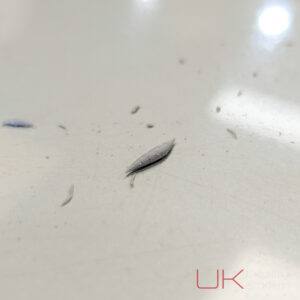
Compound clumping occurs when the carrying lubricants in your compound disappear, and you’re left with dry, slightly greasy stodge on the face of your pad with nothing to help with the friction and breakdown on the surface.
Assuming the product isn’t the issue (bottles of liquid can dry out and “cake” if left open, hence why the caps are usually pop tops), there are three things which could cause this, as those liquid lubricants didn’t just vanish into the ether – they had to have gone somewhere…
Option 1: They’ve evaporated. Likelihood – Rare (in the UK)
If you’re working in hot, dry ambient temperatures, or you’re experiencing one of three warm days we get annually in the UK, it’s possible that they’ve evaporated and dried out from the heat whilst on the panel.
Either they’ve stayed on a surface too long without being passed over, or they’ve simply exhausted themselves out after two passes.
Less likely inside, but if you’re polishing outside on a hot panel you will have a reduced working time, and products that normally behave can change their spots pretty quickly.
In hotter climates, manufacturers will adjust their products to suit local average temperatures better, compounds designed and produced for hot, humid climates, such as Southeast Asia, take longer to break down the further north you get – because they’re waiting for a higher panel temperature to be achieved before liquifying and starting to break down, and by using ingredients that react less or more with heat and humidity, manufacturers combat this for different markets.
If it’s happening to you, cool the surface, avoid warm breezes or direct sunlight over the panel if possible, run the product slower and with a faster movement speed to delay heat build up, and manage the area you’re working on to a smaller area or with a bit more compound than usual to give yourself a fighting chance – or wait until Thursday when the temperatures drop and it starts raining again (UK specific)
It’s absorbing into the paint. Likelihood – Not unusual
Much more common is that the paint you’re working on is so neglected and dry, the oils are just being sucked into the surface like grease into a sheet of kitchen paper.
You’ll see this often with older single-stage finishes that are designed to hold onto oils to retain their shine, and require waxing to replenish these as part of maintenance.
Clear coats do it too, and when you start to see clouding or hazing, it’s a fairly good assumption that at least some of those compound lubricants will draw into the surface to replenish what has been lost to solar bombardment.
To combat this, in either case, we can use a sacrificial product in the first instance to prime the paint, just as we would a pad, to prevent losing the lubricants and product we want to stay on the surface.
Any oily glaze will do, it doesn’t have to be any good, or expensive, but spending five minutes running a soft pad soaked in the stuff over the panels first to give you a thin sheen over the surface will save you time and money in wasted expensive product.
The best glazes to use will soak their oils into a piece of paper over the course of around 30 minutes leaving a greasy halo around the spot of product, so have a play and see what’s in the back of the detailing cupboard to resolve the issue.
It’s absorbing into the pad. Likelihood – Common
What goes down can also go up.
The reason we start with a primed pad is; it will help prevent too much wasted compound saturating deep into the foam, providing a wet barrier to the more viscous and cooler polish dots you add afterwards – remember we only want product on the pad face; anything that goes deeper than fractions of a millimetre is wasted.
The problem is, most people prime their pads just fine – though there are better techniques than the old four lines and spin it up method – but then they use these pads for too long without rotating them with a fresh pad.
This allows the cells to overheat and soften, and the heat makes the lubricants very thin and watery – the same as warmed-up engine oil. This can also happen if pads are damp from cleaning as the water heats up quickly being a better thermal conductor.
When it’s thinner, it can piggyback off the liquid already on the pad face and wick deeper into the foam and away from the surface where it’s needed. This causes dry matter to stay on the face and roll around without the lubricants keeping it in suspension.
The result? Clumping balls of compound are thrown off the pad and stop the face from gliding around on the surface.
The solution is to change your pad more regularly, clean it out – either with compressed air or a vacuum (we’re not a fan of brushes) –, and let it sit and think about its life choices whilst you use two additional matching pads in rotation to keep them all stable, cool and devoid of a liquid buildup.
This also has the benefit of making your pads last longer, using less product overall, and keeping the pads at their optimal density to break down DAT abrasives evenly and consistently
Are there other things that cause clumping?
Sure, but they all come back to the question: where is the liquid bit escaping?
It can only go to these three places – out, down or up…
Interested in learning more about machine polishing? Check out our Foundation and Advanced courses