
Detailing Efficiency: Our Top 5 Tips
“Work smart, not hard” gets tossed around as a throwaway phrase, but there’s real substance behind it – and in detailing, where your time is quite literally your money, small efficiencies stack up fast.
Whether you’re setting up for the first time or you just find yourself juggling too many tasks at once, here are our five top tips for squeezing more juice out of your working day.
1. Kaizen: tidy shop, tidy mind.
We’ve talked about Kaizen before – it’s a work flow principle with its roots in Japan. The “tidy shop, tidy mind” principle really does improve workflow and function – and it really is critical.
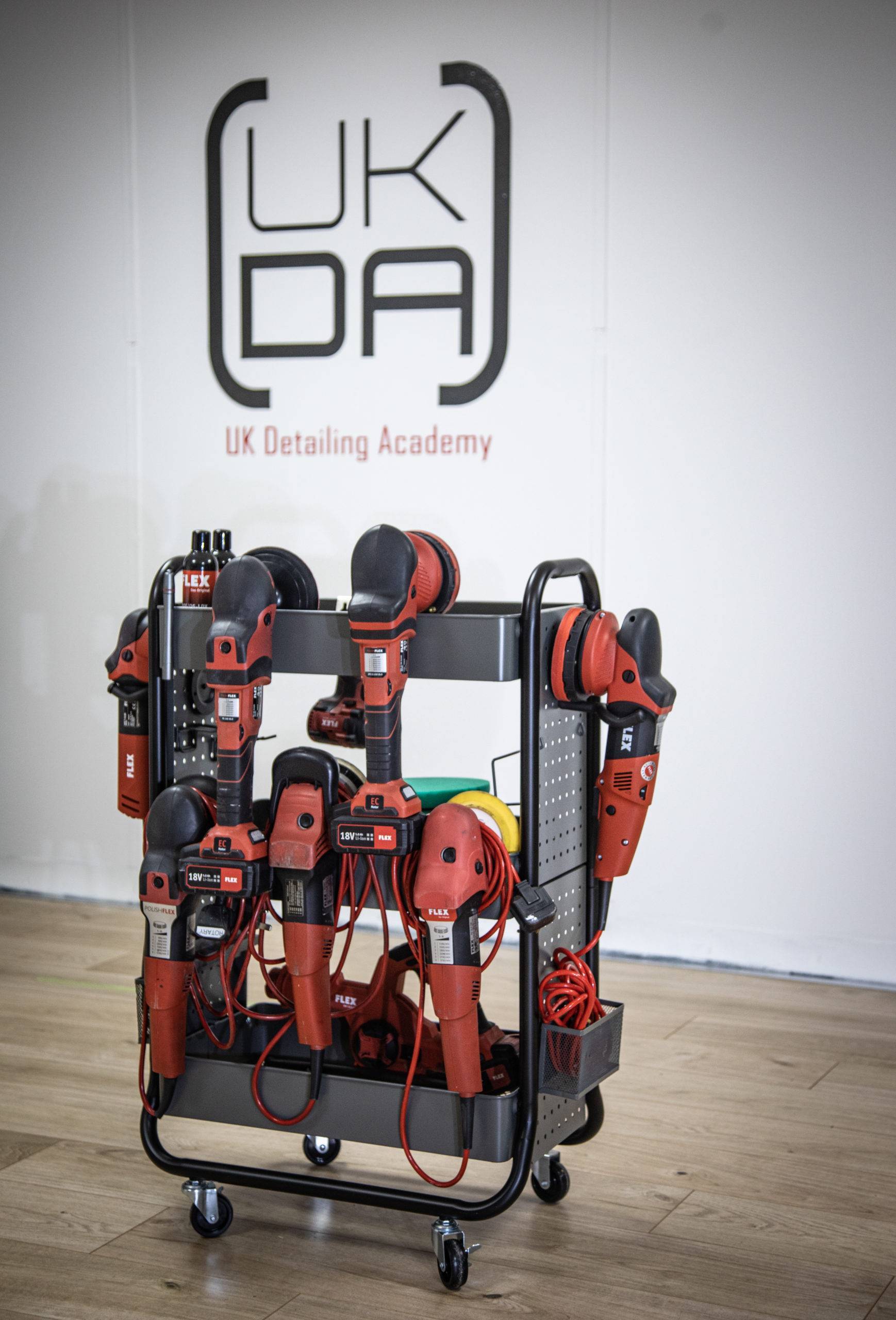
Organising your chemicals and tools on a trolley or in the van for swift access, and returning them to the same place every time, so you’re not spending 30 seconds hunting for something every couple of minutes, genuinely adds up in addition to dialling down the frustration and jarring your workflow.
Save yourself these 30 seconds every five minutes and you’ll be the best part of an hour ahead by the end of the day.
2. Follow repeatable, methodical processes.
No matter the car, the underlying workflow principle is the same: have your mental checklist set in stone and work to it. It doubles up by keeping your results consistent, but the time saving is massive.
If you complete every job in the same order, you’ll develop speed through familiarity. By all means adapt to the situation in front of you, but keep the core process consistent – your efficiency will follow as your brain finds ways to accelerate each step.

3. Batch your admin time.
Two or three times a day, set aside 20 to 30 minutes to stop and deal with admin – answer emails, return calls, invoice customers, update your social media. Don’t touch it in between these set times unless you have nothing else to do.
By not letting admin constantly interrupt your hands-on work, you protect your concentration, knowing there’s a set time for those tasks and they can wait until then. It also gives you a natural break, which stops a long job becoming monotonous and allows you to mentally reset, ready to start again.

4. Experiment (safely).
Get comfortably familiar with your compounds, polishes and chemicals, and learn exactly where their limits and strengths lie – then product choice starts to come naturally. Take the time on a slow day to practise on your own vehicle or on scrap panels with different combinations of pads, speeds and machines, because not all compounds respond the same way to different machine types and media. you might discover a time saving method or combination you’d never have found otherwise.
Find a combination that works twice as fast and, well – you can do the maths on the time saved.
5. Make a (physical) list.
On longer jobs, writing a physical list of tasks removes the chance of missing something and helps focus your mind on the overall finish. Add the small tasks as well as the big ones, cross them off as you go, but always tackle a big task first – and try to alternate, so the list moves along in satisfying fits and starts.
Your brain handles a broken-down list far better than a haphazard approach – and studies show motivation increases when there’s a clear path to completion.

Small changes, big results
Even bringing in one or two of these will pay off. However you approach it, let us know how you get on.
And if your business could use a bit of direction or coaching, our Business and Marketing course is built to help you hone and refine how you operate – and if you’re just getting going, our guide on how to start a detailing business is a good place to begin.