
Should all detailers be able to wet sand?
Sanding – whether wet or dry – is quite an advanced detailing skill. Sanding brings an element of risk to a job but one that’s worthwhile when completed correctly, and necessary if you are looking to achieve the maximum benefit for your customer. Fortunately, sanding is actually quite straightforward to pick up, once you know the basics and rules. The key, as always, is instruction, followed by practice and more practice. With our Sanding course one of the most in demand for accomplished professionals, we look at why sanding has become a key skill for high-end detailers.

Why is it an important skill to learn?
Efficiency is the number one reason. There are hundreds of different scenarios you will encounter where wet sanding will make the difference in finish, productivity and outcome. Just because you can wet sand by machine or block, doesn’t mean you’re going to be spending your time doing full mirror-finish orange peel removals on new cars though;
A – Because they’re mostly pointless on OEM finishes, usually completed without the knowledge of why OEM peel removal is usually a bad idea, and;
B – Because there is so much more you can achieve with sanding compared to abrasive polishes.
A 3000 grit sanding film or pad on a 2-5mm orbital sanding machine will cut through heavy, patchy damage in a uniform manner which would take several steps to achieve with heavy cutting, requiring only a moderate refinement if completed correctly. It does this with a combination of faster media removal, lower temperatures and even-levelling on a tight orbit. That doesn’t mean you’ll necessarily be removing much more paint than with a heavy compound over several stages; just the same, more efficiently, with a faster and easier method – when wet sanding is approached with knowledge and care.

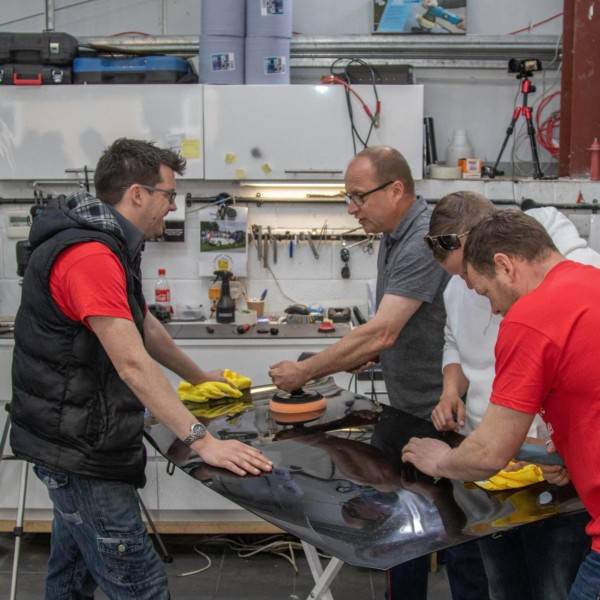
Our wet sanding course runs through all the choices, equipment, knowledge and skills you will need to tackle any wet sanding job big or small, with practical instructor-led sessions coupled and our illustrated guidebook to take away with your certificate for ongoing reference and guidance. By the end of the day you will be refining and correcting defects in a fraction of the time, with confidence and caution embedded into your workflow.
How will sanding make me a better detailer?
Wet sanding adds efficiency, options and a high degree of knowledge of paint tolerances, all essential to the successful detailer.
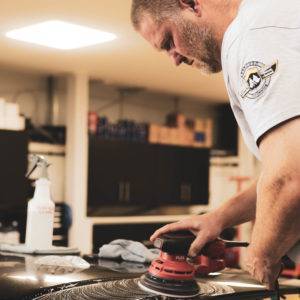
It gives you an option to turn to when heavy cutting doesn’t cut it and will allow you to level post-body shop work, blend textures, and refine heavier damage quickly and efficiently. If you’ve already spent time hand-sanding, this will take you to the next echelon. We cover small area work both by hand and with spot machines, and larger surfaces using short throw orbital sanders. We show you identifying signals when chips are levelled, or scratches filled. Finally, you are taught how to pull a matt surface back to high gloss, and how to identify and troubleshoot surface issues.
We do insist that every attendee be confident with machine correction – whether DA, Rotary or both – as there is an assumption of prior knowledge when it comes to the refinement stages. If you’re still not sure though, you can always follow up, or complete in advance, one of our Machine Polishing courses to ensure you’re up to speed before tackling anything live.
Check out the course description here, and whether you want to book a 1-1 session or take part in one of our group days, it’s a skill you’ll wonder how you did without.