

How Do I Design a Detailing invoice?
A simple one, but you need to get the details right. It’s the bit of paper every customer sees and it needs to be both compliant, legible, and clear in what they owe you for the work completed. If it’s issued ahead of work for payment in advance, this is known as pro-forma invoicing and should be marked as such, along with any references requested such as purchase order numbers which will be given to you. If you’ve completed the work and just need to be paid though, this is what you give clients as a summary of what you have done and how much it has cost them.
Designing your detailing company’s invoice template is easy, if you follow these notes.
Here’s our example with 12 essentials to feature on every invoice.

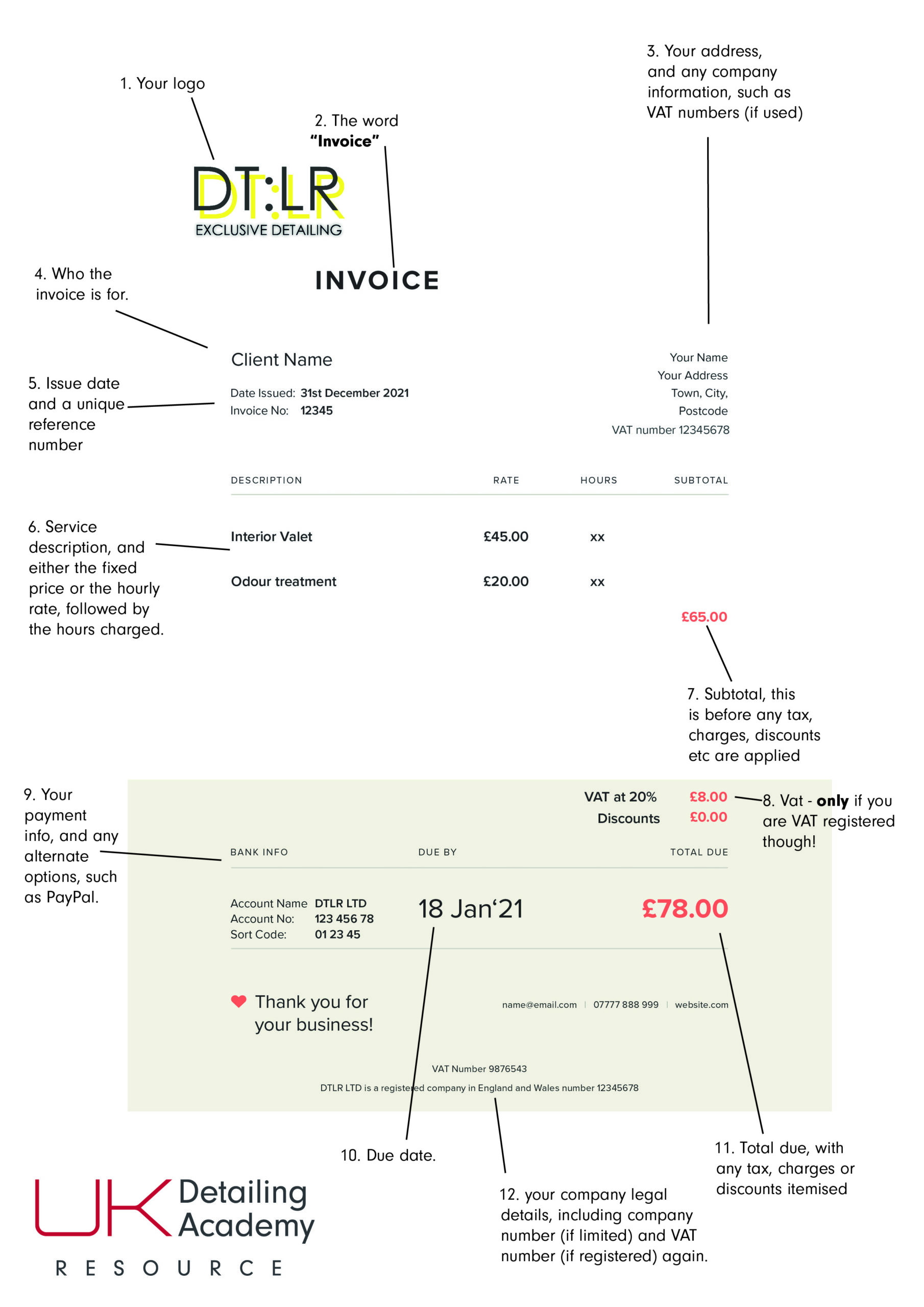
The 12 essentials:
Without these, it’s not an invoice. It’s another piece of paper. This relates to your business image, you ability to justify the demand, even you legal ability to pursue payment.
1: Your Logo –
Clients need to know who it’s from and your logo is the most recognisable part of your business. Brand it up to reflect your company in the whole layout, using a trading name they will recognise.
2: The word “INVOICE” –
Literally, if you don’t have the word on it, it’s not legally an invoice and there’s no obligation to pay until an actual invoice is received!
3: Your address and company information –
This could also include phone numbers, emails, etc, but we’ve put that further down the page.
4: Who the invoice is for, or the contact name –
most useful when dealing with other businesses, but also makes them easier to trace from your accounting perspective.
5: Issue date –
Which is where the clock starts ticking on any payment due terms, and a unique invoice number for easy reference.
6: Service descriptions –
This can be an itemised list of every service performed (your invoices may end up as short novels), or as simple as “[service] as quoted” if you have a written quote to refer to.
7: Subtotal –
Everything you’ve listed above totalled up before any additions, deductions or taxes.
8: VAT total and the percentage charged –
ONLY IF YOU ARE VAT REGISTERED. If you are not VAT registered – don’t “include” it, don’t mention it, don’t reference it. If you are – detail the percentage and amount charged.
9: Your payment info –
Include your bank details for transfer (the most common method in the UK), plus any other options you accept, such as a PayPal or a cheque address – just make sure they’re accurate and pointing to where you actually want the money to land.
10: Due date.
Unless you are working with a client’s Purchase Order system, these should reflect your Terms and Conditions and either state payment due on receipt, or a date of when the money is due.
11: Total due –
What you expect the client to pay after any adjustments, and must be clearly stated at the end of the figures.
12: Legal details.
If you run a limited company, all stationery should have your full company name and number. This is also a good place to add VAT numbers if you’re registered.
Get those details in and you’re at least running legal – and including all the information you need to get paid promptly. Invoicing is one small part of the business admin we cover on our Career Development courses, and if you’re still working out what to charge in the first place, our detailing pricing calculator is a good next stop.