
Why Your Detailing Business Needs Terms and Conditions
- reading time – 7-8 mins
It is vitally important – for both yourself and your clients – to have a documented set of Terms & Conditions in order that both you and your customer know what their liabilities are in the event of any issues involving such things as your work, the weather, accidental damage, payment, cancellation/postponement and quite possibly many other facets of your day-to-day business.
From a legal aspect, as soon as you and your client agree that work is to be completed, you are in an implied contract (whether written or not) and whilst it is generally assumed that the Contractor (you) will set out the terms of that work, it is entirely possible that the Contractee (customer) may claim their own terms, in the event of any issue, if you have not set out and made clear your Terms and Conditions of completing the job.
One such instance you may have come across if working commercially is the issue of a Purchase Order. This can, in some instances, overrule your own T&Cs and gives the customer the ability to set out their own purchasing terms which may not match your own.
So, let’s consider what aspects you may want to include in your Terms and Conditions, in order that you can display them clearly on your website for customers to read prior to booking, or send them to your customers prior to starting work. For a basic set of terms, we can divide them into four sections:

General Terms of Work
Here you will need to set out any particular requirements you may have for doing the job in the first place. For example, you might choose to put a statement like
“Prices quoted assume the vehicle is in average condition, with no excess soiling, pet hair or other heavy contamination. In the event of heavy contamination, pricing will be discussed with the client and may need to be increased or level of service decreased to account.”
This is your opportunity to show your clients what facilities you may need in order to do the work. In some cases “we will require access to a water supply and a domestic 13 Amp socket” will be relevant if you are working on a mobile basis. Consider looking at procedures in the event of bad weather meaning you might have to postpone the work as well. Ask yourself, what will you need every customer to accommodate in order to complete the work, and make sure it is spelled out clearly in both terms and conversations.

Payment terms
We would strongly suggest that you set out in some detail precisely what your payment terms are. Phrases such as “your vehicle will not be released until payment has been made” are best avoided, as they can come across as overly threatening and are difficult to enforce.
The UK has no “mechanic’s lien” in the American sense; the nearest equivalent is a common-law artificer’s (or repairer’s) lien, and that only applies where you have repaired or improved an item – not where you have simply cleaned or valeted it – so it is unlikely to help a detailer anyway. It would also not look good in court to be seen withholding somebody’s £10k vehicle keys as security over a £50 invoice… proportional response and all that.
Instead, consider writing something like “payment is due on completion” or “invoices are to be paid on receipt”, along with a clear maximum timeframe. At the end of the day and as much as it is unlikely to happen, you should always keep in mind that if a dispute does end up in front of a County Court Judge, being specific but also fair will stand you in a better light and ultimately lead to a more favourable decision.
That said, the single time I had to take a client to court, the Judge was incredibly straightforward:
Judge: Mr. X – did the claimant complete the work for you?
Mr. X: Yes, but…
Judge: No buts, he did the job. Pay him!
If only life was always so simple!

Cancellations and Deposits.
Unless you are undertaking a large volume of relatively low-value work, it is always recommended that you take a partial deposit in advance. 10-20% is normal, unless you are purchasing high value items in advance – ideally upon booking to secure the date, for example.
This deposit can be stated in your Terms as “non-refundable” or “only refundable under our discretion”, but legally means very little. It will, however, normally give you sufficient leverage with the customer to retain enough of the deposit in order that you are covered for cost of purchases in the case of a cancellation.
What if they cancel the day before though? That percentage isn’t going to cover you for the empty diary, rent, van lease costs, etc.
You can, legitimately, include late cancellation conditions where the customer becomes liable for lost earnings as a result of late cancellation, perhaps on a sliding scale for 24, 48, and over 72 hours.
You may only retain a deposit or enforce cancellation charges if you have made every attempt to fill the appointment, and you must return the deposit if you manage to secure an alternative job that uses the materials purchased.
Other than that, if it’s in your terms it’s your call whether to enforce – but bear in mind that a lost deposit or invoice without work may well often result in a lost customer, so weigh up your options carefully and we recommend you think of long-term ramifications vs short-term losses.
There are some legal requirements involved in this too. The attractively titled Schedule 2, Paragraph 5 of the Consumer Rights Act 2015 deals with this specifically, and forbids:
A term which has the object or effect of requiring that, where the consumer decides not to conclude or perform the contract, the consumer must pay the trader a disproportionately high sum in compensation or for services which have not been supplied.
What you charge should only cover your losses, and must be substantiated. Cancelling a £150 job doesn’t necessarily mean £150 in your pocket because they didn’t let you know until the night before, but if you can prove you are out of pocket by £130 as a result of – wages, materials purchased, bookings refused, efforts to fill the booking, workspace rent, etc – and only didn’t lose out of £20 because the chemicals were stock and weren’t wasted, you can invoice the customer and go through claims procedures if specifically included in terms.
Incidentally, it works both ways – if you cancel, the customer is technically owed the same, as the previous paragraph (Paragraph 4) forbids:
A term which has the object or effect of permitting the trader to retain sums paid by the consumer where the consumer decides not to conclude or perform the contract, without providing for the consumer to receive compensation of an equivalent amount from the trader where the trader is the party cancelling the contract
Worth bearing in mind, if you occasionally cancel last minute too, that some flexibility can be beneficial to both parties.
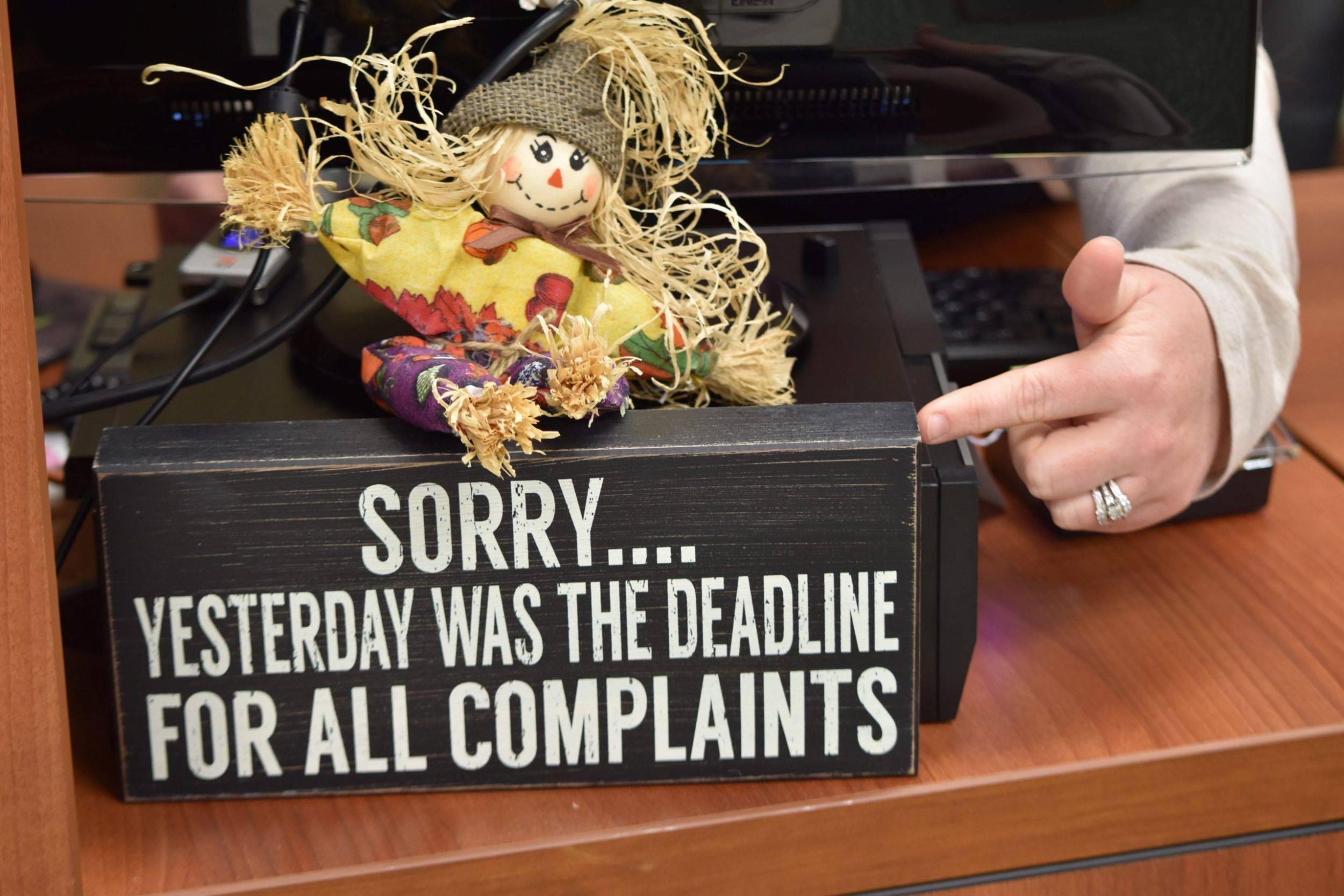
Handling Complaints.
As much as our egos rule and tell us we are perfect, it is foolish to think that we will never experience any customer complaints.
Hopefully, any minor issues will be highlighted during conversations with the client, and then noted, accepted and counter-signed on a pre-work inspection document; but you must always take account of people who have genuine complaints, may have misunderstood what they were getting, or are basically just ‘trying it on’.
“Any issues, damage or missed items must be brought to our attention immediately during post-work inspection”
– Might be the sort of thing you choose to state. As soon as you leave the site, or the customer collects their vehicle, you cannot be sure what has happened to it afterwards, so at the very least a hand-over walk-round should be completed with your customer and also perhaps signed off on your pre-work inspection. This will then make it difficult for anyone to claim for an issue you have clearly not caused, and may have occurred after the service.
At the end of the day though, your Ts&Cs do not need to be written in perfect “LEGALESE” in order to be valid. On a past website, my terms were very conversational and friendly in the way they were written – I didn’t want to put my clients off with paragraph after paragraph of cross-referenced definitions and jargon – just a straightforward setting out of individual’s responsibilities:
Whilst my approach to business is one of ease and flexibility, it is still necessary to have some Terms and Conditions in place which are summarised below for all services carried out:
- Weather – It may be necessary to postpone any booking due to particularly inclement weather. Where this happens, the booking will be remade at the earliest availability. Valet-y Details cannot accept any responsibility or liability arising from cancellations due to weather conditions.
- Cancellations – I endeavour to contact customers prior to their booking to remind them. In return, I appreciate notice if you need to cancel or postpone a booking. In the event of a no-show or cancellation within 24 hours of the appointment, I reserve the right to charge the full price for the service. This may be reduced if the service is then re-booked for a later date.
- Damage or dissatisfaction – Should you be unhappy with the result of any service completed by Valet-y Details, I need to know about it, similarly if you believe that I have caused any damage to your vehicle. Any such concerns should be raised during the final inspection of your vehicle and in any event within 24 hours of the service being completed. Valet-y Details is fully insured for both Public Liability and Accidental Damage whilst working on your vehicle.
- Excessive soiling – I will always endeavour to honour any quoted price, however in instances where there is particularly heavy soiling (pet hair, tar spots, fallout, etc) it may be necessary to spend additional time to ensure your vehicle is left in a condition that meets my high standards. Should this be required, any additional cost will always be agreed in advance of the work being completed to ensure both parties are happy with the ultimate results.
- Invoicing and payment – Payment is due on receipt of a Valet-y Details invoice, which will be sent to you as a .pdf on completion of any service. Bank details are included on the invoice to ease payment. In all cases, payment is expected to be received within 7 days of the invoice date, however should any monies still be outstanding after 14 days Valet-y Details reserves the right to charge additional sums for the chasing and recovery of any debt.
- Weather – It may be necessary to postpone any booking due to particularly inclement weather. Where this happens, the booking will be remade at the earliest availability. Valet-y Details cannot accept any responsibility or liability arising from cancellations due to weather conditions.
Terms and conditions aren’t there as the small print to slip in get-out clauses for poor work and faulty service. They are there so customers are clear on what you expect from them, what they can expect from you, and to set out what you will do to remedy any issues that may arise. Not having them exposes you to all sorts of potential issues both financial and legal, so make them easy to understand, clear and obvious to find – not hidden on a sub-menu linked FTP server they have to apply for access to – you’ve nothing to hide for good business practice!
This is just one of the business-related topics covered in our Career Development courses, which are designed to steer you in the right direction from day one of your career and give you a viable business model to shape into a success story.
If you are still weighing up the move, our guide on how to start a detailing business is a good next read. For full course details, take a look at the courses.
N.B: UK Detailing Academy are not Solicitors or legal advisors. Any advice is to be taken as from our own experience and is what WE would do to help secure our own business. It is up to you, the reader, to research and ensure your own Terms and Conditions are suitable and sufficient for the needs of your own businesses.